
“Pathways: Not sure. But modelled on Hampton Court Maze.”
Mark Neary [1]
In everyday life, pathways meander through parks or fields or forests, offering direction. A route towards a destination. The way to get from A to B. Pathways are familiar, established, well-trodden. They offer assurance. Clarity. Certainty. Confidence. “We’re on the right track”. “We’re going the right way.”
And undoubtedly pathways in health and social care offer direction, familiarity and assurance too. “We’re doing things right”. “There’s a plan.” “All will be ok.”
So, why does the term ‘pathway’ make me go hmmm…?
Well, I guess because doing things right doesn’t always mean we’re doing the right thing.
Our pathways are designed to standardise and organise. To promote efficiency and improve flow. Instead of Google maps, we have process maps, with boxes and arrows and swim lanes. There’s usually a defined place to start. One way in. A ‘Single Point of Access’. A ‘SPA’. A ‘front door’.
It’s here that your “journey through adult social care” begins. “A single contact point through which customers are screened and steered towards the most appropriate pathway to access our services.” Where “front door professionals gather the information needed to make decisions about which pathways individuals should follow” (if we don’t manage to ‘signpost’ you to ‘the community’, determine you’re an ‘inappropriate referral’, judge that you’re ‘not eligible’ or suggest you ‘come back when things get worse’. Do not pass go. We’ve successfully ‘reduced demand’. Ta da).
If you manage to pass through our gates, what a choice you face! We have assessment pathways and care pathways and integrated care pathways and complex care pathways and transitions pathways and reablement pathways and respite pathways and safeguarding pathways and hospital transfer pathways and discharge pathways and pathways 0, 1, 2 and 3 and NHS Continuing Healthcare pathways and fast-track pathways and end-of-life care pathways.
Standard pathways. Appropriate pathways. Default pathways.
Not to mention autism pathways cancer pathways dementia pathways Down’s Syndrome pathways epilepsy pathways falls pathways frailty pathways liver pathways stroke pathways…
Endless cycles of referring and waiting and screening and signposting and referring and waiting and triaging and prioritising and RAG rating and referring and waiting and assessing and planning and panels and decisions and referring and waiting and purchasing and delivering and placing and reviewing and repeating.
And repeating.
Imagine if we could invest all the time and energy we devote to classifying, channeling, complying, checking into meeting you where you’re at, and listening and understanding what matters most to you?
Into doing the right thing rather than doing things right.
In real life, where pathways intersect there are opportunities. Choices. Possibilities. But in social care serviceland, when pathways overlap there is complication and confusion, and the person (‘case’/’referral’/‘demand’) becomes ‘difficult’ or ‘complex’, with no acknowledgment of the irony of our twisted, tangled, defensive, Hampton Court Maze of a system labelling people in this way.
In real life, divergence from pathways suggests adventure… the road less travelled, getting off the beaten track, while in serviceland divergence equals ‘non-compliance’ and ‘refusal to engage’.
Pathways belong in a world which says ‘this is what we do to people like you’. Where the labels we apply determine the course of our ‘interventions’, and the decisions we make are about you without you.
Where ‘care’ is a destination and we’re assessing you for services.
These pathways are too narrow for us to walk alongside you. There’s little space for curiosity or compassion or creativity or choice in the generic routes we take.
So, what’s the alternative?
Well, if you’ve read my Rewilding social care and Kairos time blog posts, you’ll know that I believe there is much to be gained by leaving behind our industrial, transactional, sorting office language and practice, learning from nature, and adopting a more organic, fluid and nurturing narrative and approach.
In our public spaces there’s a certain type of pathway that I always love to see. From newly flattened grass to well-worn tracks, these deviations from the designed and paved indicate the paths of pedestrians, not planners. They’re known as ‘desire lines’ or ‘desire paths’ and reflect “the endless human desire to have choice. The importance of not having someone prescribe your path.” [2]
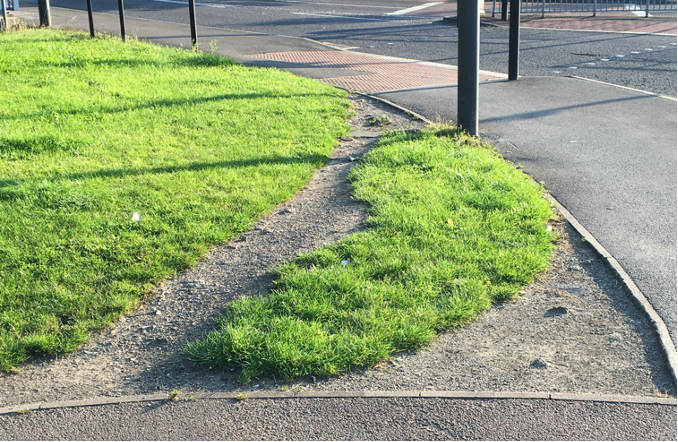
Real lives are messy, not linear. Plans evolve, and collapse. We try things out, make choices – and mistakes, change our minds, learn – and forget, feel lost – and found. We carve our own unique path, and we often require allies and advocates along the way.
If we really want to offer personalised support, we must step off the pathways of serviceland and into the unknown, where the destination is shaped by individual wishes and dreams and where, instead of putting up the barriers, we remember that our job is to remove them and help to clear the way ahead.
References
[1] Parley Vouz Health & Social Care? (An A to Z of Carespeak), Mark Neary, Love, Belief and Balls.
[2] Andrew Furman, quoted in Desire paths: the illicit trails that defy the urban planners, Ellie Violet Bramley, The Guardian, 5 October 2018

 Rewriting social care
Leave a comment