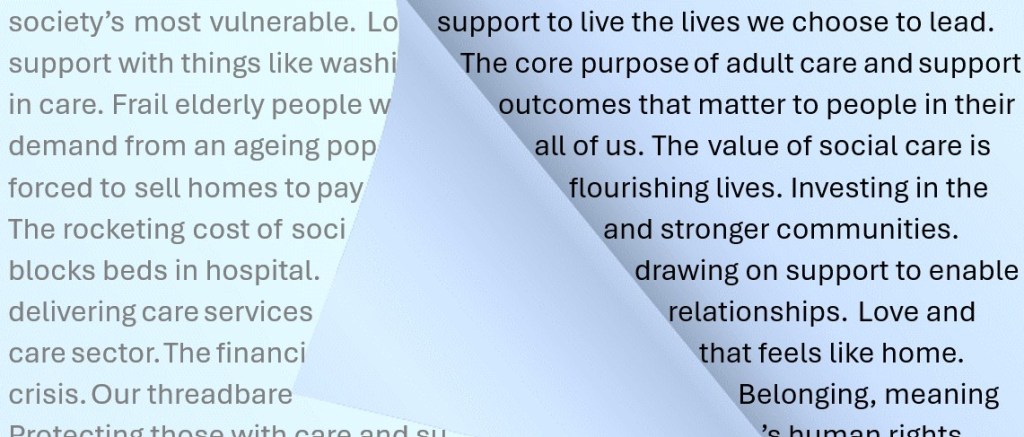
“Stories can change the world. And social care needs a better story.”
Social Care Future [1]
When I published my first ‘why language matters’ blog post five years ago, I focused on the language we use ‘in’ social care and social work to communicate with and about people, and about our practice. On the power of this language, and the attitudes and behaviours it exposes and perpetuates. On how, too often, the words and phrases we choose to use distance and divide. Blame and harm.
In that first post, I didn’t touch on the language used ‘about’ social care. On the words and phrases that dominate the public discourse. A quick Google News search for “social care” gives a good overview of this prevailing narrative. Top results (all from the last seven days or so) include references to “society’s most vulnerable”, “looking after some of the most vulnerable people in society”, “care in old age”, “personal care for the elderly and disabled”, “those in care”, “delivering care services”, “lack of social care blocks beds in hospitals”, “frail elderly people… forced to sell homes in order to fund care”, “the crisis the sector is going through” and yep, calls to “fix social care”.
I’ve written about much of this language in other blogs, but five years on from my first post, it seems like a good time to draw those musings together to illustrate the importance of flipping this narrative and telling a different story about social care.
“Society’s most vulnerable”
Back in 2018, when FrameWorks Institute researchers “took a snapshot of what the British public thinks when they hear the words ‘social care”, they summarised the collective response as “we don’t know what social care is, exactly… but we know it’s for the vulnerable”. [2]
This perception is fuelled by the narrative of local government and echoed by the media.
Scan through council websites and you’ll see numerous pages with headings like, “Are you concerned about a vulnerable adult?” “Tell us about a vulnerable person.” “Help for vulnerable just a click away.”
Pay attention to references to social care in the news and you’ll get used to stock photos of wrinkly hands. Bodies without heads. The backs of figures retreating down empty corridors. Single human forms silhouetted against windows.
This tells a story of ‘others’ – diminishing not just the identity of people drawing on support, but also the prospect of any significant reform.
The alternative story of social care is a story of us. We. Human beings with hopes, fears, wishes, dreams, gifts and potential. Human beings with human rights.
I’m not comfortable with arguments for social care investment or reform because ‘you or your family’ might need it one day. This just perpetuates them and us thinking. ‘I’m only interested if it directly affects me or the people I love.’ That’s not ok. Investment and reform are needed not because any of us might need support one day, but because many of us require support to live good lives right now.
This is a story of all of us, not them and us.
“Looking after some of the most vulnerable people in society”
The framing of people who require support as ‘vulnerable people who can’t look after themselves’ locks in the perception that people need to be cared for and protected. Looked after. Indeed, the purpose of social care is invariably framed as ‘protecting vulnerable people’ and ‘keeping vulnerable adults safe’.
Instead of looking after ‘others’, the alternative story is of people looking out for each other. A story of reciprocity, community, and love. Of freedom. Inclusion. Equality. Rights.
One of the core messages from the COVID-19 pandemic was just how much we need each other. And, during the pandemic, alongside the horrifying narrative of institutional care, there was another narrative of genuinely social care. Of an amazing collective, collaborative response which demonstrated the power of communities and just how much we do care about one another.
A response replicated in the last week or so, as love has overcome hate.
This is our social care future.
This is the future we need to invest in.
“Care in old age”
“Care in old age”. “The elderly”. “Looking after ageing parents”. The story of social care focuses on older people, illustrated with gloomy images implying loneliness and despair. There are rarely any references to, or images of, younger people – ignoring the ‘working age’ adults who draw on, and benefit from, care and support to lead the lives they choose to lead. This associates social care with decline and the end of life, not with possibilities and opportunities and flourishing lives – at every age or stage.
And older people are generally blamed for much of what’s wrong – with predictable references to “increasing demand from an ageing population”. As well as overlooking the benefits of longer lives, as with other blaming language this frames people as the problem, suggesting an inevitability to the situation and deflecting attention from decades of limited investment and imagination.
“Support with things like washing [and] dressing”
“Adult social care can include assistance with activities of daily living such as getting up / washing / getting dressed / eating / going to the toilet…”
There’s so much more to life than meeting our basic needs. But the story of social care so often stops here. Descriptions of adult social care generally concentrate on “personal care for the elderly and disabled”.
We focus on the mundane stuff that keeps people alive, not the glorious stuff that makes life worth living. And we frame social care as a safety net to catch people when they fall, rather than as a springboard to a better future.
“Those in care”
The current story of social care is of a destination. An outcome. We assess people for care, plan for care and ‘place’ people in care.
Care is something you get or somewhere you go.
But if we recognise social care as the connections, relationships, resources, and support that enable us all to live in a place that feels like home, with the people and things we love, doing the things that matter to us, we shift this narrative to care and support as a vehicle.
Instead of focusing on the support people need, we focus on the lives people want to lead, and the role of care and support in enabling people to live equal, flourishing lives.
“Delivering care services”
The framing of social care invariably focuses on services, and on care as something that’s ‘delivered’ by ‘providers’.
The ‘social care industry’.
‘Packages’ of care.
This reflects and reinforces the perception of care as a one-way transaction. Care ‘provided’ to passive recipients.
And the focus is often on the “ability of social care providers to continue delivering services” and “the financial sustainability of providers”, making ‘the sector’ the story.
But if we shift away from this transactional view of social care, if we widen the focus of our lens, we reveal a different, more hopeful story that highlights the abundance of support available in communities. Instead of dividing people up into providers and consumers of services, we recognise what people can and could contribute, and the mutual benefits of mutual support.
Like health is much broader than the NHS, social care is not, and cannot be, confined to a ‘sector’ or an ‘industry’.
“Social care happens throughout society and communities, in living rooms, on street corners, at work, in colleges and even in the pubs and night clubs across the land.”
Mark Harvey [3]
“Lack of social care blocks beds in hospitals”
Hospital discharge increasingly dominates the discourse.
Social care is blamed for ‘delaying discharges’, and ‘vulnerable patients’ are blamed for ‘blocking beds’.
People getting in the way of process. Disrupting the ‘flow’.
The language of production lines. The health and social care sorting office.
One out, one in.
There are calls for reform to ‘relieve pressure on the NHS’ and talk of expanding “services to keep vulnerable out of hospital” and prioritising “those approaches that are most effective in freeing up the maximum number of hospital beds and reducing bed days lost.” [4]
In this discourse, social care is tied to the NHS – and always in its shadow, and the focus is on investment in health and care services, not in people’s health and wellbeing.
“Frail elderly people… forced to sell homes in order to fund care”
When Boris Johnson announced his plan to ‘fix social care’ back in 2019, it came with a commitment “to protect you or your parents or grandparents from the fear of having to sell your home to pay for the costs of care.” [5]
Sally Warren noted then that “the new Prime Minister is now joining a long line of politicians, going back to Tony Blair in 1997, who define the problem as ‘removing the fear of selling your house to pay for care’ in older age. This is an extremely narrow frame of reference.” [6]
The cost of care for people and families remains a strong element of the public narrative, as does the current and future cost to local authorities.
Lines like “the cost of social care is bankrupting local councils and threatening the NHS”, “billions needed to fund rising cost of social care” and “the costs of solving the crisis in social care are eye-watering” are common in the media.
Yet again there is often a strong element of blame in this narrative, which is generally accompanied by references to – for example – the “ageing population”, “disabled people living longer and with increasingly complex needs” and “the burden of disability in the UK population.”
The fact that adult social care employs over 1.5 million people in England (more than the NHS) and contributes £55.7 billion to the economy [7] is missing from this story. As is the value of social care to the people who draw on support.
No one would deny we need to talk about money, and about the way that social care is funded. But we need to focus the conversation on investment, not spending, and on the value of care and support rather than the cost.
“The crisis the sector is going through”
- “Social care: a sector now in perpetual crisis.”
- “State of social care in England “never been so bad.””
- “Social care at breaking point.”
- “Adult social care is broken.”
Gloomy headlines like these are gloomily familiar and have dominated the narrative for years.
While ‘strengths-based’ working is promoted throughout practice, the narrative around social care – including from within ‘the sector’ – is overwhelmingly deficit-based.
What’s wrong, not what’s strong.
A dreary ‘social care is broken’ rhetoric on repeat, from “social care leaders”, “social care bosses”, “campaigners”, “experts”, “reviews”, and “research”.
Where are the stories that tell of the benefit and importance of great care and support? That highlight the potential of social care to help build better lives and stronger communities.
Where are the messages of opportunity and possibility?
Where is the hope?
“Fix social care”
- “Care leaders demand urgent government response to avert further crisis in care.”
- “Social care leaders demand more from government.”
- “To fix social care it needs around £12bn extra per year.”
Calls for the government to ‘fix’ social care are an inevitable response to the ‘social care is broken’ rhetoric, but there are multiple issues here. The endless talk of fixing removes any focus from all that is good about social care at its best. From what works, what is strong, and what can be nurtured. The focus is on repairing ‘the system’, not on building better lives. Fixing implies patching up and mending, not the reimagining that is needed. It gives the impression that the ‘fix’ is ‘just’ more money, when in reality much broader, deeper and more creative, liberating change is required. And it suggests that the ‘solution’ lies with national government, when we know that the real expertise can be found much closer to home with people, families and communities, and we know we all can, and should, play our part in creating change.
“Stories matter. They can trap us, but they can also inspire us. The stories we tell shape how we see ourselves, and how we see the world. When we see the world differently, we begin to behave differently, living into the new story… The new story becomes an invisible force which pulls us forward. Imagining the future makes it more possible.”
Jon Alexander [8]
“The vision of flourishing lives has been our joint North Star.”
Gord Tulloch and Sarah Schulman [9]
The Care Act 2014 begins with the general duty of local councils to promote wellbeing. The very first point of the associated guidance states that “the core purpose of adult care and support is to help people to achieve the outcomes that matter to them in their life.” [10]
Yet despite this clear focus on wellbeing and on what matters most to people, we’ve got trapped in a narrow, deficit-based story of looking after our most vulnerable washing and dressing delivering care services getting care going into care the sector blocking beds freeing up beds selling homes spiralling costs breaking broken fix social care now.
Oof.
Maybe it’s the narrative of social care that is broken?
If we really want to achieve the ambitions of the Care Act, and indeed our own ambitions for better lives and brighter futures, we must tell a different story. Reframe social care as something for – and about – all of us. As the web of connections and relationships and resources and support in our communities that ensures we can all live the lives we choose to lead, in places that feel like home, with the people and things that we love, doing the things that matter most to us.
Social Care Future’s research with Equally Ours and Survation found that not only does this alternative narrative “help shift mindsets about what social care is and its value, people also attach more importance to investment and reform after being presented with such messaging when compared with their default understanding.” [11]
So, let’s all do what we can to flip the narrative and tell a different story of social care – for all our futures.
And let’s keep the vision of flourishing lives as our joint North Star.
References
[1] The #SocialCareFuture gathering 2023, Social Care Future, October 2023
[2] What does the British public think when they hear the words ‘social care’? Tamsyn Hyatt, Social Care Future, 2018.
[3] Adult Social Work – 50 Years Young (and the Debate is only just Starting), Mark Harvey, Social Work, Cats and Rocket Science, 24 May 2020
[4] Letter to the health and social care sector from the Minister for Care, Department of Health and Social Care. GOV.UK, 16 March 2023
[5] Boris Johnson’s first speech as Prime Minister: 24 July 2019, Prime Minister’s Office, 10 Downing Street and The Rt Hon Boris Johnson, GOV.UK, 24 July 2019
[6] Social care funding reform: more haste, less speed. Sally Warren, The King’s Fund: 31 July 2019
[7] The state of the adult social care sector and workforce in England, Skills for Care. October 2023
[8] Citizens, Jon Alexander, Canbury Press, 2022
[9] The trampoline effect: redesigning our social safety nets, Gord Tulloch and Sarah Schulman, Reach Press, 2020.
[10] Care and support statutory guidance, Department of Health and Social Care, GOV.UK, Updated 28 March 2024
[11] Building public support for a brighter social care future in 5 easy reframes – quick read, Social Care Future, October 2023

 Rewriting social care
Leave a reply to suzannemorrison12 Cancel reply