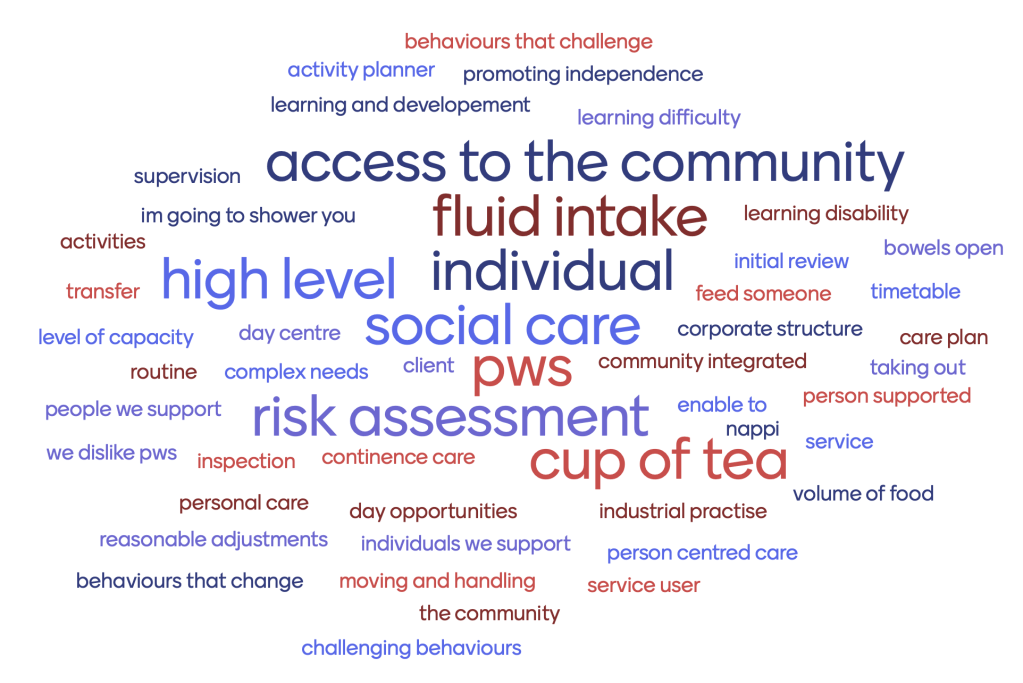
Last week, me and Tricia Nicoll held half-day Gloriously Ordinary Language intro sessions with two of the organisations joining our May programme. Early in each session, we asked people to share some of the words and phrases that they hear or read or use in their organisation that they would not use in the kitchen with their family, or in the café or pub with their mates.
Usually when we do this, people mention words and phrases like ‘service user’, ‘client’, ‘challenging behaviour’, ‘complex needs’, ‘accessing the community’, ‘personal care’… and indeed all these ‘words that make me go hmmm…’ featured on the word clouds generated by people’s responses.
We’re always very keen to stress that Gloriously Ordinary Language is not about policing language, or banning words, or having a list of words to avoid and words to use instead (you can hear us talking more about this in Episode 3 of our Gloriously Ordinary Language Myth Buster series). What Gloriously Ordinary Language is about, above all else, is being curious.
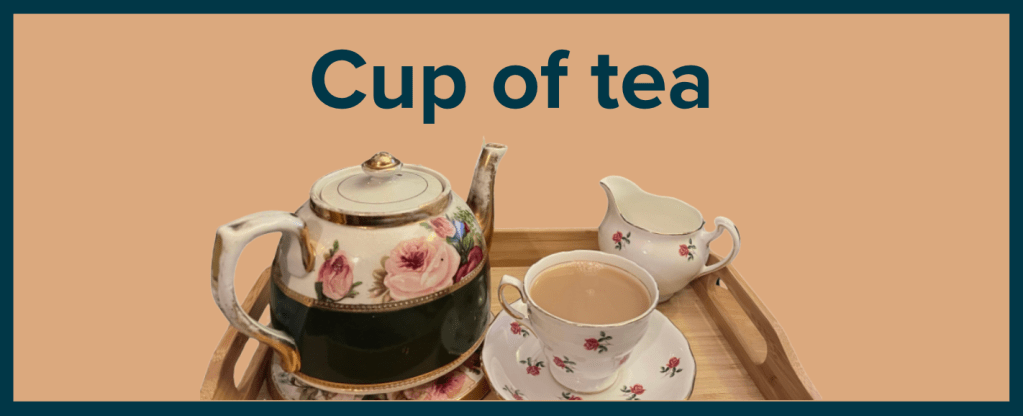
And we were curious to see ‘cup of tea’ appear in the ‘cloud’ in the first session.
Surely ‘cup of tea’ passes the ‘kitchen table’ test, as Gloriously Ordinary Lives Test Two is increasingly becoming known by the organisations that have completed the programme?
Surely a cup of tea is about as gloriously ordinary as you can get?
Well – one of the reasons I find language so endlessly fascinating is that, when we really pay attention to how a word or a phrase is used, and consider what it reflects and represents – we reveal so much about perceptions and practice and power. Indeed, I was interested to see Carrie-Ann Dickens reflect – in her recent Community Care article about ‘Lessons from CQC’s assessments of local authority adult social care provision’ – on the difference in language used in “stronger systems” and more “pressured environments”. She wrote that “often it is the small details – how people are spoken about in meetings, how records are written – that reveal the true culture of a system.” [1]
So, it transpired, there were two reasons ‘cup of tea’ got a mention.
The first reason was because the phrase represents lack of choice. Now if you do drink tea – and several people on the call said they don’t – you’ll no doubt have a preference about leaves or bags, caffeinated, decaffeinated, fruit or herbal, the brand (Yorkshire for me, obviously!), how long the teabag stays in – quick dunk or long soak, how much milk (whole, semi, skimmed, oat, almond…), sugar, sweetener to add – or not add, and even which cup or mug or teapot to use. But there is often an assumption in serviceland not just that people want a cup of tea (as opposed to any other drink), but that it comes with milk and sugar too. A one-size-fits-all, default drink symbolising a one-size-fits-all service.
“…it is recommended that a cup of tea be given on waking, and that breakfast be served at a more normal hour, such as 8 a.m.”
– The King’s Fund Committee on Hospital Diet, 1943 [2]
Tea as a task. A transaction.
Delivering ‘care’.
“Staff were kind but did not have time to chat to people. People told us they were bored and did not have enough to do. We saw that some people sat all day with no stimulation or interaction from staff beyond tasks such as offering a cup of tea or personal care. Although some activities were provided on three mornings each week, these had not been developed in line with people’s interests. People told us they never went out other than into the garden during the summer.”
– Care Quality Commission inspection summary, 2022
And the second reason was the way the phrase is often used as a distraction. A way of workers diffusing a situation (‘challenging behaviour’, an ‘episode’, an ‘incident’) or diverting a conversation.
A way of shutting down or silencing whatever is being communicated.
“When people became distressed, we observed staff knew how to offer effective support, offering a hand to hold, or a cup of tea, a chat about holidays or a game of football.”
– Care Quality Commission inspection summary, 2024
Never mind, let’s have a nice cup of tea.
Tricia added a third reason too. As she said, if she came into my house and offered me a cup of tea, I’d be a bit nonplussed. It’s my house, surely it should be me offering her a drink? So, who is offering the cup of tea, and what does that tell us about people living in a place that feels like home to them?
“I can’t even make my own cup of tea. It’s always no don’t do that. I went to get a cup of water and they said no they’ll do that for me.”
– Care Quality Commission assessment, 2024
The conversation moved on, but I’ve been thinking about it since then.
I actually met a friend for – you’ve guessed it – a cup of tea that afternoon, and I mentioned the discussion to her. We both talked about what a cup of tea means to us – so much to her that she felt she could probably write a book about it! We’re both single-parents so neither of us have partners bringing us tea in bed, and we both shared the feelings of envy we experience when we see people on Zoom or Teams calls being handed a mug mid-call! She remembered how, post-separation, she’d happened to be at her ex’s house dropping off her kids and, exhausted, had asked if he might be able to make her a cup of tea. He’d asked how she took it, speaking volumes about their previous relationship. And I recalled times when I’ve stayed with family and friends who have brought me tea in bed, and how joyous and luxurious that has felt.
I wrote in this And equally for healthcare 💟 blog post about tea in an NHS mug feeling “as good as a hug’. An act of love. And to me a cup of tea does equate to love. To warmth and comfort. Company and conversation, even celebration, and to quiet time and space alone.
So much more than just ‘managing and maintaining nutrition’, ‘fluid intake’, ‘hydration’…
“Crisp toast for breakfast, a delicious lunch with a friendly word, a cup of tea willingly served in the middle of the night can do wonders. Food is a form of medicine.”
– Independent review of NHS hospital food, 2020 [3]
In their article on ‘Humanising the ‘machinery’ of care’, Charlie Jones and Martin Seager write, “in an older people’s ward a terminally ill man commented that he appreciated a nurse making him a hot chocolate after she’d finished her shift. He felt that she went out of her way to be kind to him, he felt that he mattered, and he was touched – “She sort of broke the rules for me.” The well-intentioned ward manager responded to this by introducing a ‘hot chocolate round’ as part of the routine care on the ward; it became part of the ‘machinery’ of care rather than an act of spontaneous kindness.” [4]
In serviceland, a cup of tea, as with so much that starts with good intentions, so easily becomes a task, a transaction, a routine. Scheduled and delivered. Done to and for.
In serviceland, a ‘cup of tea’ too easily becomes part of the ‘machinery’ of care.
So, if we’re serious about creating Gloriously Ordinary Lives, how about we forget the glossy strategies and transformation plans, and start by thinking about those cups of tea?
References
[1] Lessons from CQC’s assessments of local authority adult social care provision, Carrie-Ann Dickins, Community Care, 10 April 2026
[2] Spoonful of sugar: hospital food and medicine, Lynsey Hawker, Hong-Anh Nguyen, Nikki Smiton and Nicholas Willsher, The King’s Fund Library, 2021
[3] Spoonful of sugar: hospital food and medicine, Lynsey Hawker, Hong-Anh Nguyen, Nikki Smiton and Nicholas Willsher, The King’s Fund Library, 2021
[4] Humanising the ‘Machinery’ of care, Charlie Jones and Martin Seager, Resurgence & Ecologist, Issue 313, March/April 2019


Leave a Reply