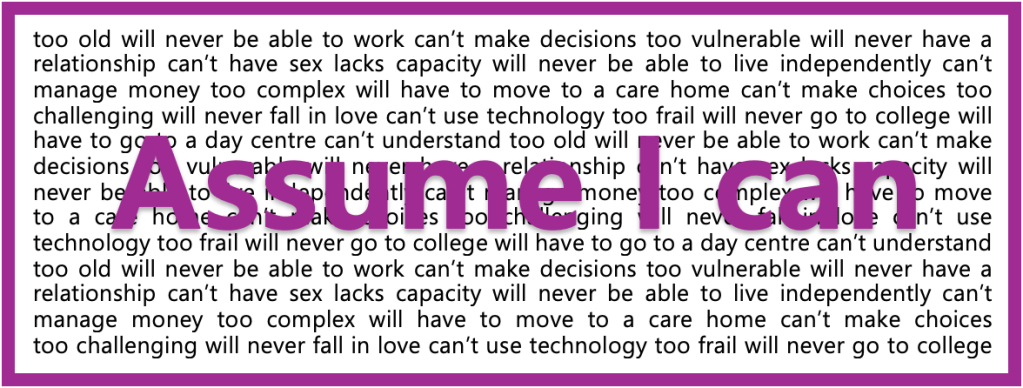
I’ve been thinking a lot about assumptions recently, prompted by our Gloriously Ordinary Co-production Together programme session this week about Test Three for Gloriously Ordinary Co-production: Are we clear that we need each other?
We all make assumptions all the time.
Assumptions shape our lives, from the small things – that the corner shop will have milk when we run out, that the bus will be on time – to the big, life changing decisions based on expectations about our health, our relationships, our income, our future.
We assume we can, and so we do.
Or we assume we have time, more days, more years, so we don’t take that holiday, don’t make that call, don’t say ‘I love you’ enough, or at all.
We assume we can one day, and so we don’t yet.
We make assumptions about family and friends too, and in turn they make assumptions about us. Often these assumptions keep us going. They influence the choices we make and the decisions we take.
They assume we can, and so we do.
But family and friends also assume we can’t, and so we don’t.
And we easily assume we can’t, and so we don’t. We assume we can’t be a ‘leader’ so we don’t apply for that promotion, and we miss out on that job. We assume we can’t ask a friend who is having a tough time for help, so we don’t, and they feel even more useless. We assume we can’t challenge and change practice because ‘this is the way we’ve always done things around here’, so we don’t bother trying, and nothing ever changes.
Assumptions shape our lives. And if we require a little, or a lot, of extra support to live them, our lives are often controlled by the assumptions people and organisations make about us.
Here are three assumptions I heard in recent meetings – all on the same day:
- “Most of the people on our waiting list are in care homes so we know they are safe.”
This was from a social work team manager. Do we know people living in care homes are safe? Do we all make assumption about institutions and services ‘keeping people safe’? Please read this powerful article by Ellisa Novak about her Grandma’s experience. She writes, “like many people, I was brought up to trust that public institutions will protect us when we are at our most vulnerable. Even when I could not understand the motivations of decision-makers in my Grandma’s case, and even when I witnessed first-hand the severe neglect and appalling conditions she and other residents were experiencing, I still believed that someone, somewhere, would do something to help.” [1]
- “He’s not safe to live at home as he can’t manage his medication.”
This was from a Community Psychiatric Nurse (CPN), suggesting to a social worker that a man – I’ll call him Jack – who had recently left hospital wasn’t safe at home because he was forgetting to take his medication. I’ve been taking antibiotics for a gum infection this week, and being a bit rubbish about remembering the three tablets I have to take each day. One day I forgot whether I’d taken the breakfast dose and had to count the remaining tablets in the pack to be sure I had. The next day I missed the lunchtime dose. Yesterday I thought I’d taken the final tablet and threw the packet away, then went for a walk, doubted I had taken it, got home and retrieved the packet from the bin to find the final tablet still inside! I obviously need help to manage my medication. Does that mean it’s not safe for me to live at home? As the social worker who shared the CPN’s assumption said, Jack had been living in a hospital where medication was administered to him, so remembering to take his own was going to take a bit of getting used to. She also said when she has to take medication, she puts a reminder in her phone to prompt her. I’d thought of doing that, but instead I left the antibiotics on the kitchen table and assumed I’d remember them. Gloriously Ordinary Lives folks.
- “He doesn’t have any friends because he’s blind.”
This was from a student social worker. Genuinely.
In my Rewilding social care blog post, I wrote that “if a plant isn’t thriving, we automatically assume the conditions aren’t right – not that there’s an issue with the plant itself – and we try changing the environment it’s in. Maybe it needs more water, or more light. Maybe we need to improve the soil it’s growing in or create more room around it. Contrast that with our approach to supporting people, where we view them as problems and set about fixing them, paying little or no attention to the environment around them.” [2]
We assume the problem with the social care world we know is mainly lack of funding and we don’t (or don’t want to) recognise that the most essential, influential, problem with the social care world we know is that we assume people equal problems – and we make proclamations and decisions about people’s lives and people’s futures based on those assumptions.
In one of Tricia Nicoll’s Gloriously Ordinary Sundays podcasts, Marianne Selby-Boothroyd mentions that when her youngest son, “who has a learning disability and a whole host of other things going on in his life”, was born, “we were still in the delivery room and the consultant came in. The only two things he said were ‘don’t feed him sausages’… yeah, he was still attached to the placenta at the time… ‘don’t feed him sausages and there are lots of special schools, you’ll be ok’. And his older brothers had just started at their local community infant school – they even had community in its name – and I just thought, oh, is this it now for him?”. Marianne goes on to describe how, from those early days, she felt “pushed into a different way of living for him”. She also says, “I think it is so hard for families when they have a baby or a small child or an older child that’s suddenly given a label. I think it becomes really hard not to be, um, this is quite a harsh word, but infected by the language of the system.” [3]
Thanks to Marianne becoming “a bit militant”, her ‘Littlest Prince’ did go to his local primary school just like his older brothers. “There he went and there he thrived.”
But labels stick and language exposes and fuels the assumptions we make about ourselves and each other.
“What starts as a note stating I cried in an appointment, becomes a letter that details a “difficult appointment”, which takes flight as a descriptor of me as a “difficult person”, which ultimately leads to a doctor I only just met describing me as “difficult – as expected.”
– Wren Aves [4]
So back to our Gloriously Ordinary Co-production session. In the session, me and Tricia Nicoll shared this briliant video, which we both love.
Then we asked people to think about the assumptions they make in their jobs. About where in their organisations they are making assumptions about what people can and can’t do.
Here are a few they mentioned:
- Assuming that disabled people can’t work.
- Assuming that older people don’t desire sexual relationships.
- Assuming that because it’s written in a plan someone can’t change their mind.
Co-production week starts tomorrow. A week of webinars and articles and stories about professionals involving and engaging and empowering those people with problems and problem people, to make services better.
How did we get to a place where we assume this is what co-production means?
And celebrate it?
Co-production – genuine, authentic, Gloriously Ordinary Co-production – is about creating Gloriously Ordinary Lives, not just better services. It’s about connecting with, and investing in, people and places. Recognising and rewarding the value of all the work all of us do – not just the stuff that earns money but the most important work in all our lives, like bringing up children, and supporting our families and friends. And most importantly, it’s about remembering everyone something to offer, and that we need each other.
No more throw-away people.
When we asked people for their headlines at the end of the session, here are just a few of the fantastic things they said:
“We all need to be needed.”
“Everyone is valuable.”
“Challenge your assumptions. believe in the possible and look at what everyone can bring to the table.”
Assume I can, and maybe I will.
References
[1] Overturning Cheshire West and my Grandma’s experience of ‘the death house’ care home, Ellisa Novak, Open Justice Court of Protection Project, 25 June 2026
[2] Rewilding social care, Bryony Shannon, Rewriting social care, 8 April 2023
[3] The Gloriously Ordinary Lives Team is growing… Meet Marianne Selby-Boothroyd! The Gloriously Ordinary Sundays Podcast, 6 October 2025
[4] Mental Health Clinical Notes: The Curse of the Paper-Self, Wren Aves, Psychiatry is driving me mad, 22 August 2021


Leave a Reply