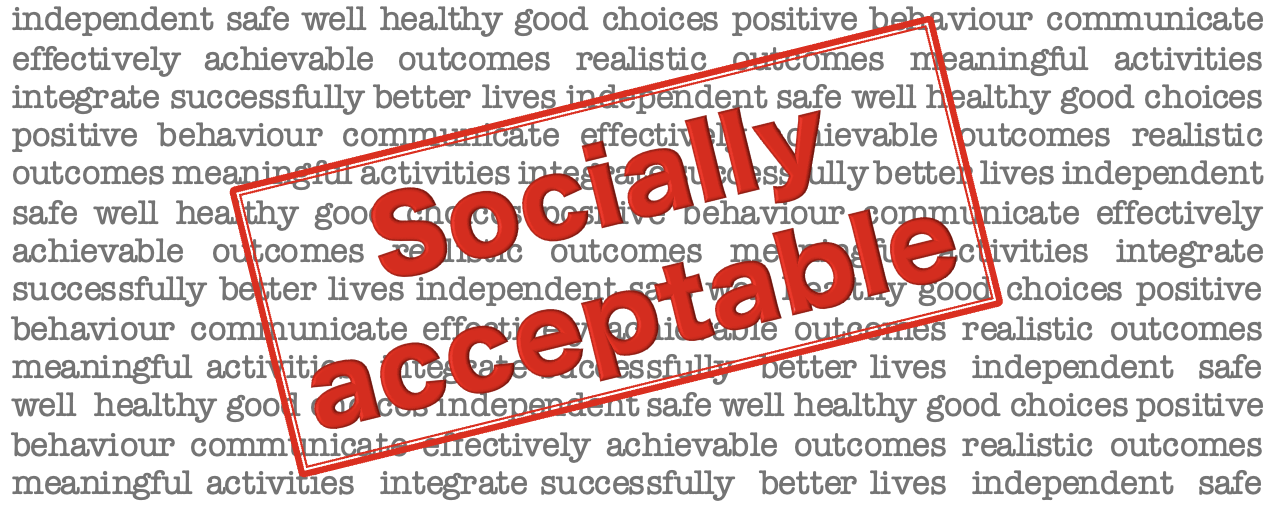
“That makes me think that “social care” is sometimes about being socially acceptable.”
This comment appeared in the Zoom meeting chat in a recent Gloriously Ordinary Language session where we were looking at the language councils and care and support organisations use to communicate about the purpose of social care.
It’s such a powerful observation. And, you know, I couldn’t agree more.
As ever, when we really pay attention to the words and phrases we use, we reveal the attitudes and agendas that lie beneath.
And so often our language exposes the dominant perception and assumption that people equal problems.
That people have problems, and/or are problems.
Socially unacceptable.
You have a problem if you don’t fit the standard typical normal human mould.
Autistic Spectrum Disorder. Attention Deficit Hyperactivity Disorder. Learning difficulties. Communication problems. Sensory issues. Behavioural challenges. Those with needs. The less able. Struggling. Suffering. Not all there.
Disorders. Deficits. Difficulties. Problems. Issues. Challenges. Needs.
Less than ‘normal’.
Less than human.
You are a problem when you don’t do what is expected of you. Don’t conform. Don’t comply. You’re difficult. Challenging. Complex. Hard to reach. Refusing to engage. Oppositional. Resistant.
You’re also a problem because, to be honest, you’re in the way. Demand. A burden. A bed blocker. Inappropriate referral. Revolving door customer. Frequent flier. High intensity user.
None of this language acknowledges the barriers and the battles in our one-size fits all world.
None of this language exposes the absence of listening, understanding, empathy, awareness, presence, flexibility, curiosity, trust, common sense and humanity in our one-size fits all world.
Problems require a solution. If people equal problems, then something must be done. Historically of course the solution was separation. Segregation. Removal from public life.
“a person who is a defective may be dealt with under this Act by being sent to or placed in an institution for defectives or placed under guardianship…”
– Mental Deficiency Act, 1913 [1]
The institutions of old are no more, but the institutionalisation continues, not just in terms of the segregation and locked doors but also in terms of the beliefs that pervade and invade. Neil Crowther writes that “institutionalisation is really about the dismantling of the self”, [2] and The Equality and Human Rights Commission define an institution as existing when “the interests of the organisation itself tend to take precedence over the residents’ individualised needs or wishes.” [3]
When the aim is to make the unacceptable acceptable.
So here are ten common words and phrases that frequently appear in the social care story told by councils and care and support organisations. All ten expose our obsession with changing people instead of challenging outdated attitudes and structures and systems that don’t acknowledge or accept that we are all different, and that that’s ok. In fact, it’s beautifully human.
All ten expose how far we’ve strayed from the legislation which protects our rights to choose how we want to live our lives – which should surely be the purpose of social care and of all our roles too?
1. Independent
‘Independent’ is probably the word that appears most frequently in the story we’re telling about the purpose of social care. The ‘i-word’ often lacks an explanation (“we want you to be independent”), leaving it wide open to interpretation, and misinterpretation.
“When I say I want independence my social worker tells me she will end my social care package then I will have independence.”
– Julie Sharp [4]
Sometimes though the meaning is explicit.
“We provide support to people in cost effective ways to enable them to reach or regain their maximum potential so that they can do as much as possible for themselves.”
We “want you to stay well and independent for as long as possible, so our support isn’t needed.”
“We help service users to manage for themselves where possible rather than becoming totally dependent on care workers and others.”
To depend on other people is not socially acceptable. Ironic really, given how we all depend on other people. None of us exist in isolation. We all need each other.
While independence *should* be all about our right to choose how we want to live our lives – freedom and autonomy and choice and control – generally what we really mean is ‘we want you to stop costing us money.’ To stop being a burden. A drain on our resources. And indeed, some adult social care strategies and plans say just that, mentioning ambitions to “increase service user independence to reduce the financial value of care packages” and maximise independence to “minimise costs to the taxpayer”.
2. Safe
“We will safeguard and protect individuals.”
“We want to keep you safe.”
The dictionary definition of ‘safe’ is “things that do not involve any risk”, but a life with no risks is no life at all. As Lord Justice Munby famously observed, “what good is it making someone safer if it merely makes them miserable?” [5]
“A ship in harbor is safe, but that’s not what ships are built for.”
– John A Shedd [6]
This ambition focuses on protecting people instead of protecting people’s rights, restricting lives and liberty. It also places the accountability for safety solely on institutions.
“Keeping people safe is really important for the Council.”
It makes processes and plans and professionals responsible for safety. It fails to acknowledge our collective responsibility for looking out for each other and overlooks the extent to which connections and relationships and meaning and purpose and belonging – not services – help us all feel safe.
3. Healthy
“We support people to lead healthy lives.”
“We want people of all ages who experience mental health problems, have learning disabilities and/or Autism to live healthy lives.”
The World Health Organization defines health as “a state of complete physical, mental and social well-being and not merely the absence of disease or infirmity” [7] and of course we have a duty to promote wellbeing under the Care Act 2014.
But ‘healthy’ is a loaded term and I can’t help feeling that our ambitions for healthy lives focus more on challenging and changing individual lifestyles – diet, exercise etc – rather than on health inequities and the social determinants of health.
“Our support teams visit people at home and create an individual support plan to help them establish a healthy daily routine.”
Indeed, the Care Quality Commission’s ‘Supporting people to live healthier lives’ quality statement affirms this, seeking assurance that “people are encouraged and supported to make healthier choices to help promote and maintain their health and wellbeing.” [8]
4. Making good choices
‘Choice’ is of course a fundamental element of our legislation, though in reality choice so frequently resembles Mark Neary’s astute definition – “an opportunity to pick between one thing or nothing.” [9]
“We aim to help our service users exercise the opportunity to select from a range of options in all aspects of their lives.”
That ringfenced ‘choice’ speaks volumes. And somehow, we’ve translated the idea of ‘well-informed choices’ – definitely a Care Act 2014 ambition – into ‘good choices’.
“We use positive support to encourage good choices.”
“We can support you to make good choices.”
Good choices.
Appropriate choices.
Socially acceptable choices
But what counts as ‘good’? Who defines appropriate? What about bad choices? Poor choices? Unwise decisions? We’ve all made those and maybe regretted them but generally learnt from them. Maybe we’ll make them again, or maybe we won’t.
It’s our choice.
5. Behaving positively
In social care serviceland, ‘behaviour’ is something you have. ‘A behaviour.’
Then “behaviour becomes a “problem” instead of being recognised as a sign of one”. [10]
And problems must be fixed.
So, we “find ways to manage and reduce behaviour.”
We “encourage positive behaviours”. “Alternative, more appropriate behaviours.”
“We support the individual to develop safer more positive behaviours to replace the original behaviour.”
We “prepare them to behave in a socially responsible manner.”
The way we act reflects our feelings. We communicate through our behaviour, and we often show what we may not want, or be able, to say.
When we restrict restrain medicate treat we also ignore and suppress and fail to ask or listen or understand.
And we fail to acknowledge the impact of our own behaviour.
6. Communicating effectively
As well as modifying behaviour, we’re keen to modify communication that doesn’t fit with our idea of ‘normal’.
Communication that’s a ‘problem’ or a ‘difficulty’ or a ‘challenge’ or a ‘need’.
“We aim to empower those with disabilities to communicate more effectively.”
“We can help you find new ways of getting your message across.”
“We will help you find new ways to communicate.”
You need to change, because we don’t understand you, and that’s your problem.
Really?
7. Setting achievable outcomes
“Our team works closely with individuals to set achievable goals and provide the support needed to reach them.”
“Personal outcomes need to be meaningful and achievable for people.”
“We measure the progress of the people we support towards realistic outcomes set by themselves.”
Not only do we require you to have ‘outcomes’, but we expect them to be Specific, Measurable, Achievable, Realistic and Time Limited.
“Outcomes must be SMART.”
Do our own hopes and ambitions and desires meet the SMART criteria? I suspect not.
This is how serviceland translates aspirations into ‘unrealistic expectations’.
This is how we trample on your dreams.
8. Engaging in meaningful activities
“The ‘outstanding’ person centred support we deliver helps to engage our service users in meaningful activities.”
“We will ensure access to meaningful daytime activities.”
“We give adults with learning and physical disabilities the opportunity to take part in meaningful activities which are outcome focussed.”
We’re super keen for your activities friendships relationships employment life to be ‘meaningful’. But who decides what’s meaningful? Meaningful to who? And what about the meaningless, trivial, insignificant stuff of ordinary lives?
Although the fact you are a ‘service user’ being ‘engaged in meaningful activities’ suggests you’re not actually living an ordinary life. Your weeks may be full of ‘activities’ to fill your days and keep you ‘busy’, but are you doing what matters most to you?
Can you be exactly who you want to be?
Are you needed? Or just seen as needy?
Will anyone miss you if you’re not there?
9. Integrating successfully
“With the right level of input and support, many individuals are able to live happy, independent lives, and integrate successfully into their wider community.”
“We aim to empower and strengthen service user’s practical, social and emotional skills in preparation to become a responsible member of his or her community.”
“We aim to make our service users full members of the community.”
Seriously?
I have no words, so I’ll share Mark’s brilliant insight once again:
“Integration: A reminder that you will always be on the outside & meaningful life can only be bestowed on you by an insider.”
– Mark Neary [11]
10. Leading a better life
“The goal of our service is to support adults living in the borough to lead better lives.”
“We support people to have a better life.”
Our arrogant assumption is that your life is a bit rubbish, and that we can make it better.
Maybe life is great and you want some help to keep it that way. Or maybe it would be better if we got out of the way.
And anyway, who decides what’s ‘better’?
Does better mean an ‘ordinary’ life – the life you choose to lead?
Or does better mean managing on your own staying safe being healthy making good choices behaving positively communicating effectively setting achievable outcomes engaging in meaningful activities and integrating successfully?
Does better mean you fit into our boxes and our schedules and our pathways and our services and our budgets and our expectations?
Does better mean socially acceptable?
References
[1] Mental Deficiency Act 1913
[2] Somewhere north of Preston, Neil Crowther, Making rights make sense, 21 July 2020
[3] Strengthening the right to independent living, Equality and Human Rights Commission, 12 May 2021
[4] When I say I want independence… Julie Sharp, Twitter, 25 April 2024
[5] Local Authority X v MM & Anor (No. 1) [2007] EWHC 2003 (Fam), Bailli, 21 August 2007
[6] This quote is widely attributed to John A Shedd, original source unknown.
[7] Constitution, World Health Organization
[8] Assessment framework for local authority assurance, Care Quality Commission, 8 April 2026
[9] Parley Vouz Health & Social Care? (An A to Z of Carespeak), Mark Neary, Love, Belief and Balls
[10] Diagnosis: Human, Elly Chapple, Flip the Narrative Publishing, 2026
[11] Parley Vouz Health & Social Care? (An A to Z of Carespeak), Mark Neary, Love, Belief and Balls


Leave a Reply